Atgal
E-commerce Marketplaces Uncategorized

Convert your visitors into newsletter subscribers

Learn how to convert your visitors into newsletter subscribers with effective strategies that grow your email list and increase engagement.

21 Sau 20253min. skaitymo laikasIeva TreilihaIeva Treiliha

Engaging with potential and existing customers online can be challenging. That is why it is essential to set up conversion opportunities on your website to help you communicate more effectively with your visitors.

Depending on your goals with your newsletters, you can use them to inform your visitors about new services or products, new content on your website, to gain more followers on social media, or to collect more reviews on Trustpilot.

Newsletters are an effective way to communicate with your visitors, but how do you get them to sign up in the first place? – You can read more about that in this blog post!

Why is it important to have a newsletter?

If you do not already have an email list, it is important to start collecting email addresses right away. Newsletters are an effective – perhaps the most effective – way to connect with former, current, and potential customers.

On Facebook, Instagram, and many other channels, your reach is affected by the platform’s algorithm, which means you may not be able to reach all your followers as effectively as you can with email newsletters.

Here are some additional email marketing statistics:

  • Salesforce has conducted a study showing that for every $1 invested in email marketing, the average return is $38. That means the ROI (return on investment) for email marketing is an impressive 3800%!
  • We all use our mobile phones a lot. BlueHornet found that 80% of us delete emails that are not optimised for mobile devices.
  • Reports from Statista show that in 2017, there were 3.7 billion email users worldwide. This number was projected to grow to 4.3 billion by 2022.
  • Research from Omnisend shows that sending three abandoned cart emails results in 69% more orders than sending just one email.
  • In a Statista survey from 2017, 49% of respondents said they would like to receive emails from their favourite brands on a weekly basis.

The whole point of email lists is to convert first-time visitors into loyal customers. You can achieve this by developing an engaging email strategy, sending the right emails at the right times. Remember, less sometimes is more – none of us wants to receive spammy sales emails several times a day.

It is rare that people who visit your website for the first time will make a purchase straight away. BUT if you can get these first-time visitors onto your email list, the chance of them making a purchase in the future increases significantly.

How do you start building an email list?

Once you have found an email marketing provider that offers all the features and tools you need, you can start focusing on converting your visitors into newsletter subscribers.

When choosing an email marketing provider, remember that it is important to have access to various features that suit your email marketing strategy. Some of the most important features you will need are:

  • Various sign-up forms
  • The ability to segment your subscribers based on their behaviour
  • The ability to send automated newsletters based on these segments

If you are a beginner, MailChimp is a really good email marketing provider, and you can try the tool completely free of charge.

There are many ways to entice your visitors to sign up for your newsletter. Some methods are more discreet, while others are a bit more assertive. You can read more about the different opt-in methods below…

#1 Standard email opt-in

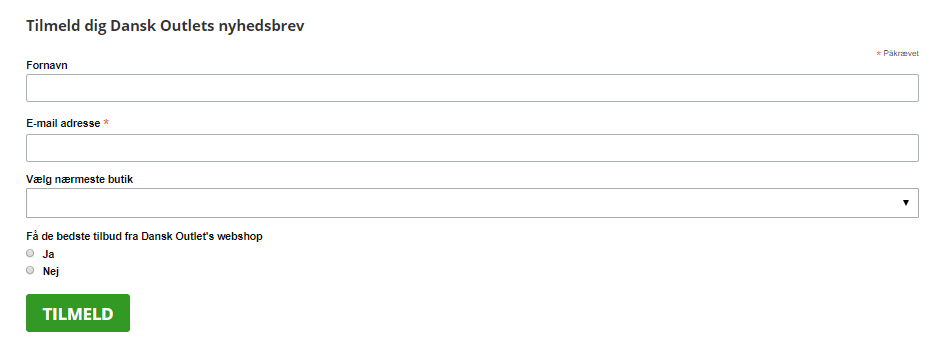
Make it easy for your visitors. It should be simple for your visitors to find the sign-up function and subscribe to your newsletter. This process can be optimised by having a straightforward sign-up form in the footer of your website or a clear menu item in your main navigation.

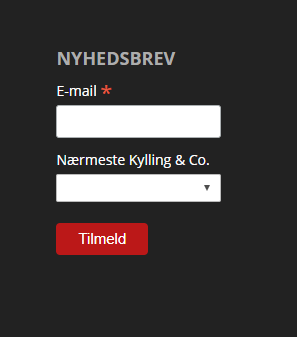
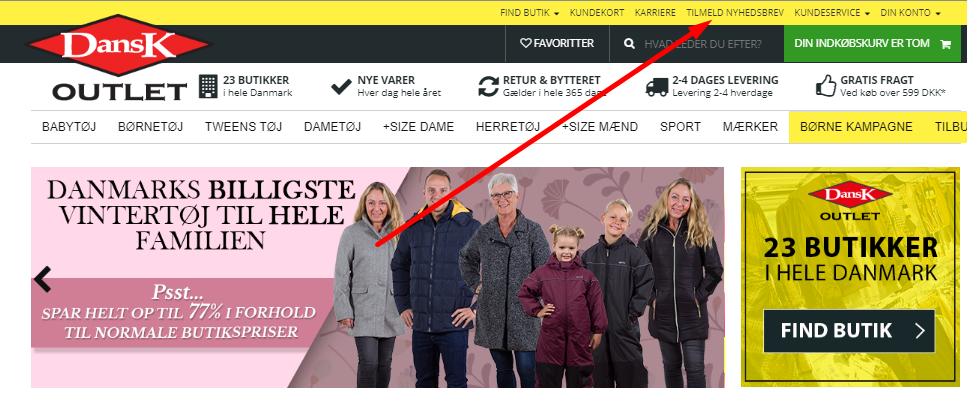
You can see examples from Dansk Outlet and Kylling & Co. below:

  • Discreet sign-up function in the footer:
  • Menu item:


#2 Pop-up with an incentive

A more assertive approach to collecting email addresses for newsletters is using pop-ups. You have probably experienced this: you visit a website and suddenly a form pops up, trying to get you to subscribe to the company’s newsletter, offering a free download of their latest e-book or something else entirely.

Too many pop-ups, or pop-ups that cannot be closed, are among the most annoying things you can encounter as a website visitor. That is why it is important to carefully consider how and when you want these forms to appear on your website.

Where?

You can usually choose where on your website you want your pop-up to appear. Depending on your strategy, you need to assess where it will be most effective – centre screen, or perhaps in one of the corners?

It is a good idea to test several different pop-ups in various sizes and placements. Once you have tested several options, you can review the results – which version convinced the most visitors to sign up for your newsletter?

Based on this information, you can then fine-tune the final version of your sign-up pop-up.

When?

You can usually choose when a sign-up form should pop up on the visitor’s screen. Here, I also recommend testing several different combinations to find out what works best for your audience.

Pop-up after a certain number of seconds on the page

This is a pop-up that is shown to your visitors after a specific number of seconds or minutes on your page. It is about finding the right balance. If the pop-up appears too early, the visitor will likely decline as they have not had enough time to look around your site, but if it comes too late, you risk the visitor having left before the pop-up appears. I recommend testing several time intervals and choosing what works best.

Pop-up after a certain number of viewed pages

This pop-up is shown to your visitors after they have viewed a certain number of landing pages on your site. For example, you can set it so that all visitors who have viewed three pages will see a pop-up inviting them to subscribe to your newsletter. Here, you can also test various options to see what works best for your audience.

Pop-up after the user has scrolled down the page

With this type of pop-up, you decide how much of the page your visitors should have seen/read before they get the invitation to subscribe to your newsletter.

Pop-up when the user is about to leave the page (exit intent)

Exit intent pop-ups are very popular and, in my experience, a very effective way to collect newsletter sign-ups. Exit intent pop-ups appear as soon as the visitor moves the mouse away from the browser window to leave the site. It is a great moment to catch the visitor’s attention and offer them an “incentive” if they sign up before leaving.

Why?

To encourage customers to sign up for your newsletter, you need to make it appealing – ideally, they should not want to miss out. Even if you have the UK’s best and most exciting newsletter, it can still be difficult to get people to sign up.

To convert more visitors into newsletter subscribers, you can use small tricks – the so-called “incentives”. This can be anything, such as:

  • Discount codes
  • Access to an e-book, template, calendar (or other relevant material)
  • Exclusive access to something or a sneak preview
  • Free shipping on the next/first order
  • Chance to win something
  • Referrals (if a subscriber gets a friend to sign up, both receive a gift)

People love exclusivity and the opportunity to save. It does not have to cost a fortune. Small perks can make a huge difference 🙂

Get more newsletter sign-ups

No matter how much you work on your email opt-ins or pop-ups, it can still be difficult to convince people to sign up for your newsletter.

This is often because many people are worried that they will end up receiving irrelevant spam all the time. That is why it is important not only to offer something extra to your customers but also to make it clear in your sign-up form that you will only send emails twice a week, or only when you have new products in your shop, or a sale, or something else of value.

You can also give your customers the option to choose how often they want to receive newsletters. For example, let them select whether they want daily, weekly or monthly emails from you. You can then segment these customers into different groups and send your emails according to their preferences.

Once you have converted your visitors into newsletter subscribers

Once you have people through the door, you should work hard to keep them. There is a fine balance between sending too many newsletters and too few. However, it is not just the frequency of your emails that is crucial – the relevance of your newsletter content is equally important.

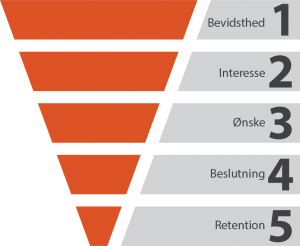
When you have got people to sign up to your newsletter, remember the classic Marketing Funnel, where all consumers are divided into five groups based on how engaged they are with your brand:

1.Awareness – consumers who are aware of your brand, but not much more than that

  1. & 3. Interest & Desire – consumers who are considering buying your products/services and comparing you to your competitors
  2. Decision – consumers who are ready to buy your products or services
  3. Retention – consumers who have purchased from you before and have the potential to become loyal customers

Each stage in the funnel has its own role. Your goal is to move your potential customers further down the funnel until they eventually become loyal customers. When planning your email marketing strategy, you should consider each stage of the funnel. How can you most effectively communicate offers and information about your brand to potential customers at every stage?

It may seem like an overwhelming amount of work – segmenting potential and existing customers and setting up tailored emails for each stage of the Marketing Funnel – but it is not as complicated as it sounds. Most email systems actually have tools for setting up automated email flows, allowing you to tailor messages to the part of the funnel where the customer is. Read more about setting up email flows in MailChimp here.

I hope you have gained some insight into how to convert visitors on your website into newsletter subscribers. If you have any further questions or need help getting started with email marketing, you are always welcome to contact us here or call us on 71 99 34 74.

Do you want to see what your competitors and your industry are doing best?

At WeMarket, we offer businesses a benchmark report that compares their marketing efforts with their key competitors. You decide which competitors we should compare against.

We specialise in selling physical goods online and growing webshops – and now you can benefit from this expertise, even if you’re not already a client.

It’s completely free.

  • 1.

    Konkurentų analizė

  • 2.

    Sektoriaus potencialas

  • 3.

    Rekomendacijos